You Can’t Landscape Your Way Out of Bad Urban Design
There is a quiet epidemic shaping our cities.
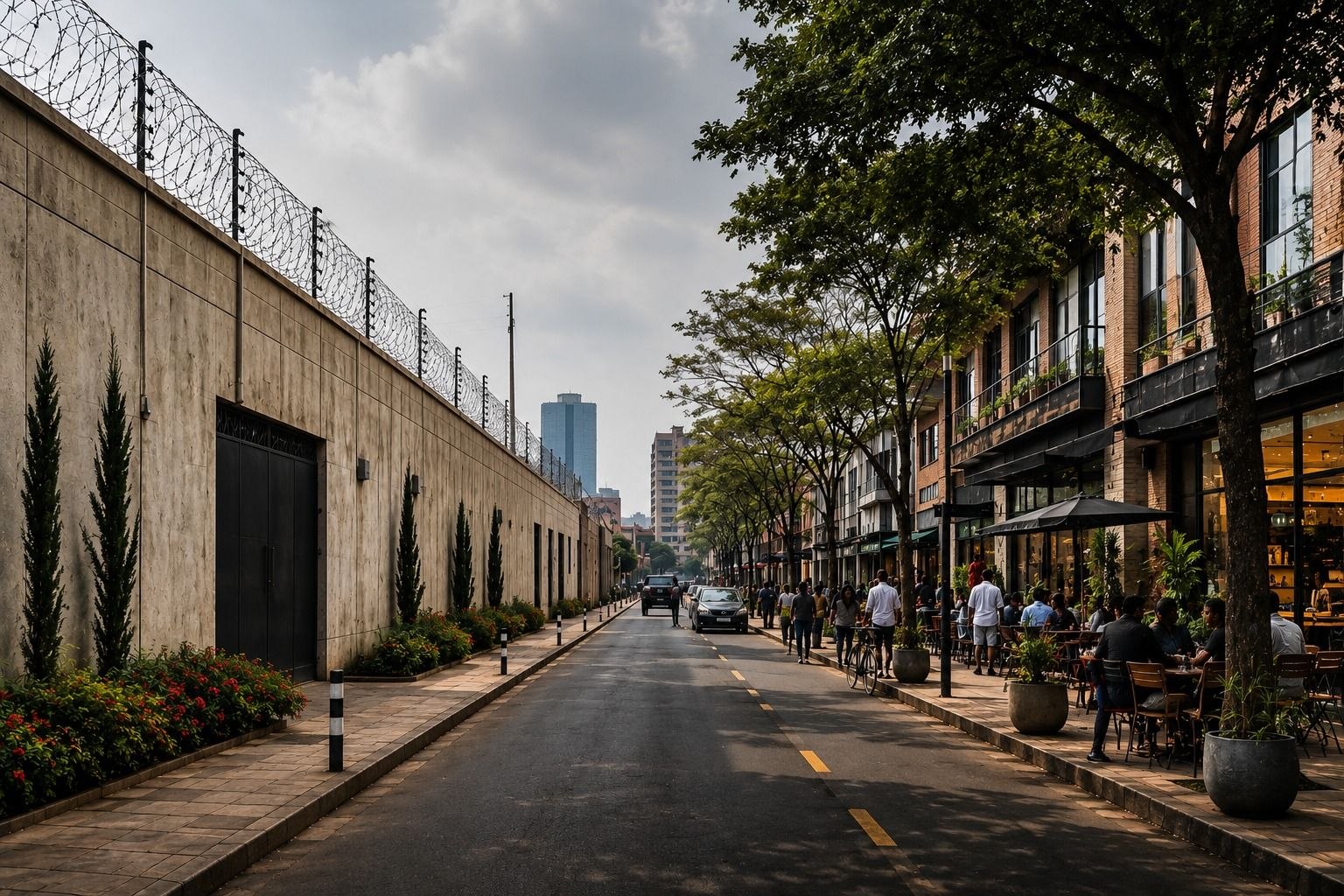
It does not announce itself with noise or collapse. It builds walls. Three metres high. Topped with razor wire. Electrified. Then clad in stone; because we must pretend this is elegance. Lined with flowers; because we must pretend this is care.
And just like that, we call it Architecture.
The Architecture of Withdrawal
We are no longer designing Spaces; we are designing exits.
Inward-facing developments have become the default response to Fear, Status, and Control. The brief is predictable, almost mechanical: Maximize privacy. Fortify the perimeter. Minimize exposure.
What is never written, but always delivered, is a clear disengagement from the city. Buildings turn their backs. No windows addressing the street. No entrances acknowledging it. No life spilling into it. Just walls. Long. Silent. Cold. A declaration, not of safety, but of withdrawal.
Walk along one of these walls. Not past it - along it. There is nothing to see. Nothing to engage. Nothing to hold your attention. So, you move faster. Or you leave.
This is what we call a dead edge; an urban frontage that contributes nothing to public life. No transparency. No activity. No exchange.
Now repeat it. Plot after plot, street after street. What you get is not a city, it is a corridor of absence; a place designed to pass through, not belong to.
The Security Illusion
The justification is always the same: *security. *But let’s call it what it is: fear, dressed up as design.
Walls feel powerful. Gates feel controlled. Barriers feel like protection. But feeling safe is not the same as being safe. And architecture that prioritizes comfort over reality is not protection; it is delusion.
Jane Jacobs told us this long ago: cities are safest when they are watched, used, and lived in. Not when they are sealed off.
Eyes on the street. People. Because people notice. They intervene. People create consequence.
A blank wall does none of that. It only hides. And what is hidden is easier to target, not harder. A street no one can see is a street no one can defend. So, we build the walls higher, add more wire, hire more guards - and wonder why the fear never leaves.
The problem was never the street; it was our decision to abandon it.
Cosmetic Lies
We have become masters at creating problems, then decorating over them. We plant creepers, add textured finishes, heck, we commission murals to soften the violence of disengagement with aesthetics.
But let’s not lie to ourselves: A decorated wall is still a wall, and a wall is still a refusal. To engage. To contribute. A refusal to belong. Landscaping cannot fix what urban design, or lack thereof, has already broken. You cannot beautify absence.
The Cost We Pretend Not to See
When buildings turn inward, cities pay. Quietly. Gradually. Completely.
Streets lose life, informal economies disappear, walkability erodes, trust dissolves and slowly, the city stops feeling shared. It becomes fragmented and defensive. Suspicious. A collection of private islands connected by public space no one claims.
We start designing for escape, not for encounter; for movement, not for life.
And let’s be honest; this is not just a client problem. Yes, clients ask for security. Developers optimize for exclusivity, and yes, planning regulations often allow it. But Architects? We draw the walls. *Draw. *We justify them. We refine them. We aestheticize them. We have taken disengagement, and turned it into a design language.
That is not neutrality. That is participation.
The Line We Need to Draw
What if security did not mean separation, but presence? What if value was measured not just within the plot, but also along its edge? What if we went back to judging a building the way we ought; by how it contributes to its surrounding? Active frontages. Visible life. Universal user-centered.
This is not idealism. Architecture does not end at the gate; it begins there. If every plot becomes a fortress, the city becomes a void. And no amount of landscaping will save it.
We can continue building beautiful walls and wondering why our cities feel empty. Or we can start designing with the street, again.